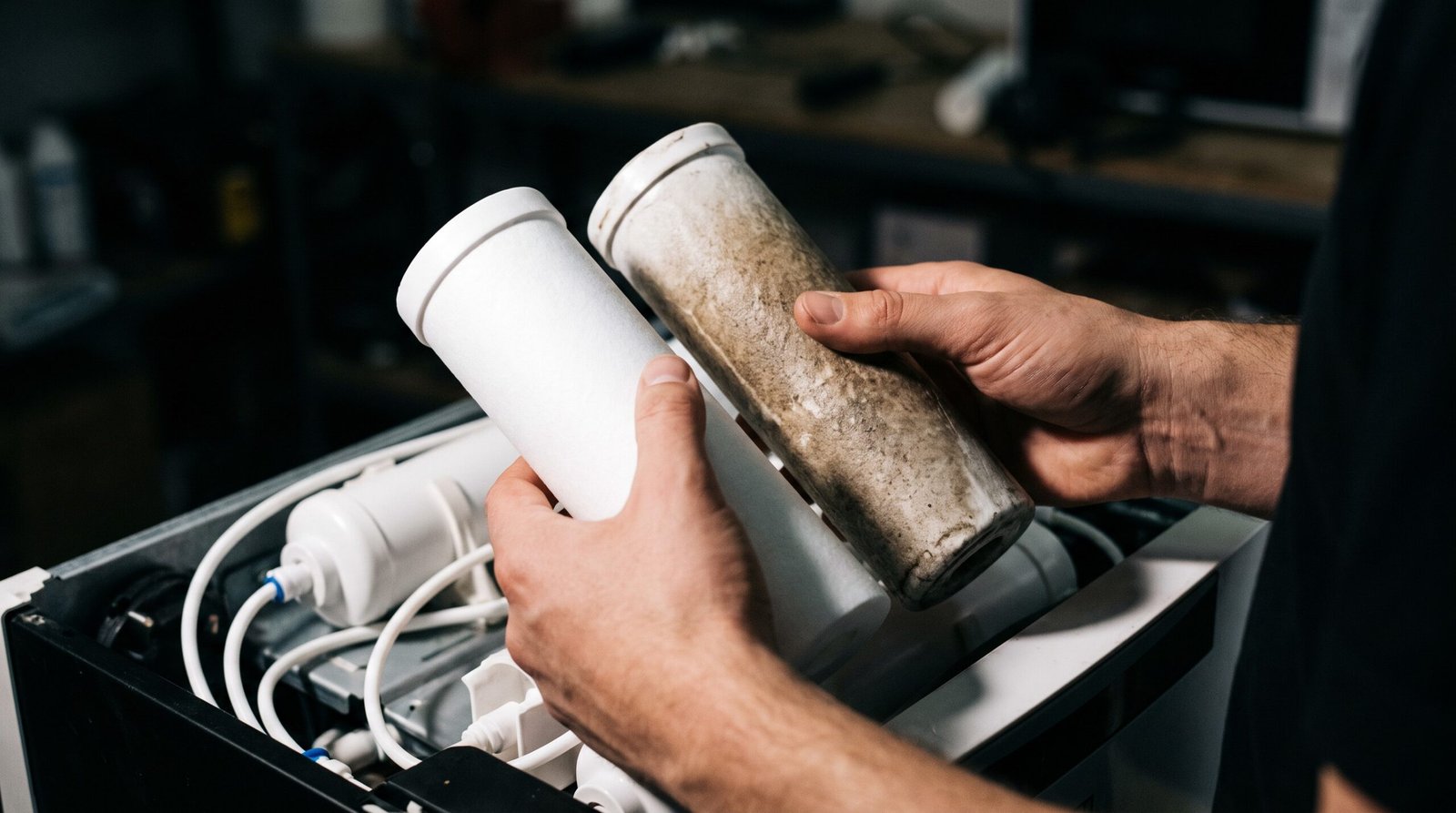
Reverse osmosis unit, bottled water cooler, rainwater harvesting, atmospheric water generator: these four solutions are often presented as competitors. Yet they do not answer the same question, and only one of them depends on no water network at all. An honest comparison, including the French rules that changed in 2024.
1. Four solutions, four different logics
Before comparing prices, compare what each device actually does. Two of them treat existing water, one stores it, and only one produces it.
| Solution | Water source | Needs mains water | Needs electricity | Drinking water out |
|---|---|---|---|---|
| Reverse osmosis unit | Tap water | Yes | Model dependent | Yes |
| Bottled water cooler | Purchased, delivered | No | Yes (hot/cold) | Yes |
| Rainwater harvesting | Rain | No | No (pump aside) | No (see section 4) |
| Atmospheric water generator | Humidity in the air | No | Yes | Yes, after treatment |
That grid settles most of the false debates. A reverse osmosis unit is useless on the day the tap gives nothing. A water cooler produces nothing: it shifts the problem onto a delivery round. Rainwater harvesting does not supply drinking water as French law defines it.
2. Reverse osmosis: excellent on quality, tied to the mains
Reverse osmosis pushes water through a membrane that holds back almost all dissolved salts, metals and many micropollutants. On final quality it is a proven technology, used in domestic and industrial settings alike.
Its two limits are structural. First, it needs a pressurised water supply: no network, no water. Second, it continuously discharges a concentrate — the fraction of water carrying what the membrane retained. The rejected volume varies widely between models, and it is worth checking on the technical data sheet rather than on a sales page.
Reverse osmosis is therefore the right choice when water does arrive but needs correcting. It does not answer a question of availability.
3. The bottled water cooler: simple, but permanent logistics
A water cooler has the advantage of obviousness: no work, no plumbing connection, and water whose quality is guaranteed by the bottler. That is why they are found in so many offices.
Its real cost is measured per litre, delivery included, and it never falls: every litre consumed has to be bought, transported, stored and taken back. Add the weight of the bottles, the floor space they take up, and the maintenance of the cooler itself, whose cleanliness determines the quality of the water served.
It is a convenience solution, not an independence one. It remains entirely dependent on a supplier and a van.
4. Rainwater: the French rules changed on 1 September 2024
This is the point most online comparisons still get wrong. The order of 21 August 2008, long cited as the reference text, has been repealed. It was replaced by the order of 12 July 2024, in force since 1 September 2024, issued under article R. 1322-94 of the French public health code.
That new text places rainwater in the category of water unfit for human consumption. The classification is in the name: rainwater harvested at home is not drinking water, and cannot become so through domestic filtration alone.
The permitted domestic uses are listed exhaustively: flushing toilets, washing indoor floors, washing laundry, watering, cleaning outdoor surfaces and vehicles. Depending on the use, a declaration or an authorisation is required. The text also requires a sanitary logbook recording every operation carried out on the installation — an obligation from which single-family systems in individual houses or private areas are exempt.
In other words: rainwater harvesting is an excellent way to cut your drinking-water consumption for uses that do not require it. It is not a source of drinking water, and presenting it as one is unlawful.
5. The atmospheric water generator: the only source independent of any water network
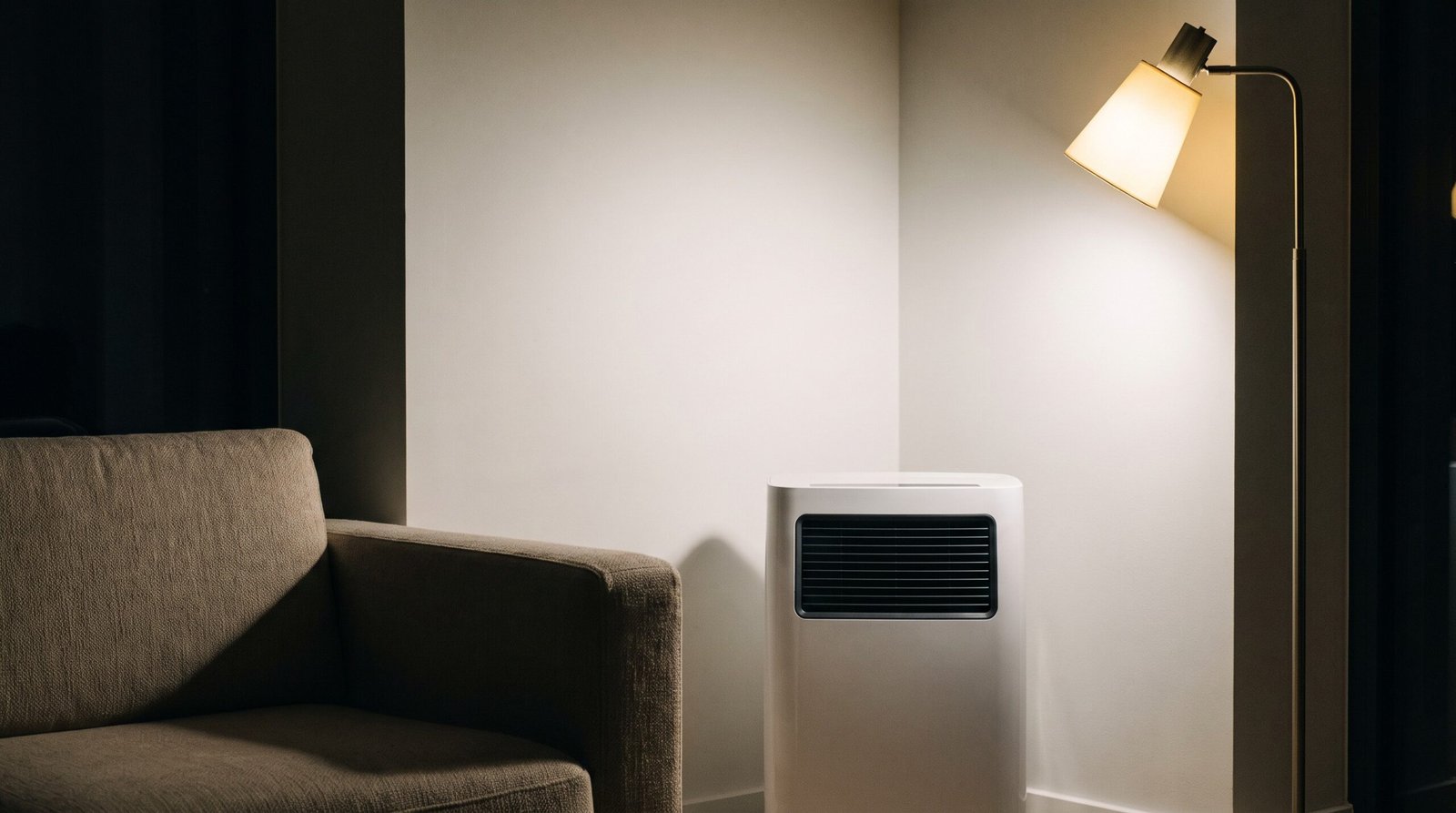
An atmospheric water generator condenses the vapour held in the surrounding air, then treats that water to make it drinkable. Its distinctive feature in this comparison is simple: it draws nothing from the mains, depends on no delivery, and does not depend on rain either. We cover how it works in what an atmospheric water generator is used for.
Its constraints are just as clear. It needs electricity, continuously. Its output depends on the warmth and humidity of the air: the same machine does not produce the same volume in northern France and in Guadeloupe, as our article on the French overseas territories shows. And condensation alone is not enough to make water drinkable: the downstream treatment does that, a point we explain in why condensation water is not always pure.
6. How to decide
The useful question is not “which is best”, but “what am I short of”.
- Water arrives but does not suit me (taste, limescale, concern about pollutants): reverse osmosis is the most direct and the cheapest to run.
- I want cold water with no building work, in an office: the cooler remains the simplest, provided you accept a permanent cost per litre.
- I want to cut my drinking-water bill on toilets, laundry and the garden: rainwater harvesting, within the framework set by the 2024 order.
- Water does not arrive, or not always — cut-offs, rotating supply, remote sites, building sites: the atmospheric water generator is the only one of the four that produces drinking water in that situation.
These solutions combine perfectly well, incidentally. Nothing stops you flushing your toilets with rainwater and producing your drinking water another way. To put figures on the last option, see our article on the price of an atmospheric water generator and our criteria for choosing a model.
Conclusion
Comparing these four devices on purchase price alone makes no sense: they do not deliver the same service. Three of them assume water already arrives, one way or another. Only one produces it. That criterion — dependence — decides the choice long before the budget does.
Sources
- Order of 12 July 2024 on the sanitary conditions for using water unfit for human consumption for domestic purposes, issued under article R. 1322-94 of the French public health code. In force since 1 September 2024 (article 17), repealing the order of 21 August 2008 (article 16).
- French Ministry of Health, Domestic use of water unfit for human consumption.
- French public health code, articles R. 1322-94 et seq.