An atmospheric water generator is not a plug-and-forget appliance. It makes water meant to be drunk, out of air that carries dust, pollen and micro-organisms. Maintaining it is therefore not a question of performance: it is a question of potability.
1. Why maintenance governs water quality
The machine works by cooling air until the vapour it holds condenses. That air first passes through a filter, then meets a cold wet surface, and the water produced is stored before being served. Every one of those stages is a place where something can build up.
Condensation alone does not produce drinking water: it produces demineralised water that has travelled through a circuit. The downstream treatment — filtration, disinfection, sometimes remineralisation — is what makes it drinkable, a point we cover in why condensation water is not always pure. A saturated filter or a spent UV lamp does not only cut the flow rate: it removes the last barrier between the room’s air and the glass.
2. The four maintenance points on a domestic machine
The air filter
This is the first barrier and the hardest worked. It holds back dust, pollen and particles before the air reaches the condensation zone. Once clogged, it cuts the airflow, drops production and forces the compressor to work harder — consuming more to produce less.
The water-circuit filters
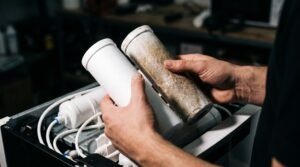
After condensation, the water passes through one or more filters, often activated carbon. They correct taste and hold back some dissolved compounds. Their life is measured in volume treated as much as in months: a machine that produces a lot wears them out faster.
The UV lamp
Many machines disinfect the stored water with ultraviolet light. A UV lamp does not blow like a bulb: it gradually loses intensity while still lighting up. It therefore appears to be working when it no longer disinfects. That is why replacement follows a duration rather than an observed failure.
The tank and the circuits
Any water stored at room temperature encourages a biofilm to develop on the walls. Cleaning the tank periodically, following the manufacturer’s procedure, is part of normal operation, not of a repair.
3. What maintenance changes in practice
| Neglected item | Effect on production | Effect on the water |
|---|---|---|
| Clogged air filter | Lower output, higher consumption | More particles upstream |
| Saturated water filter | Reduced serving flow | Altered taste, weaker filtration |
| Spent UV lamp | No visible effect | Disinfection not assured |
| Uncleaned tank | No visible effect | Risk of biofilm |
The second column explains why maintenance gets skipped: the two items that matter most for health cannot be seen. A machine with a dead UV lamp and a fouled tank keeps producing exactly the same volume of water, at the same speed, looking exactly the same.
4. Video tutorials, step by step
We publish ten tutorials filmed by Eaurigine on its G30 model, showing the real handling rather than describing it: opening the front cover, removing and refitting filters, servicing the air filter, replacing the three UV lamps. They are gathered on our Resources page.
The exact moves differ from one model to the next, but the logic is the same everywhere: a cover to open, cartridges to unclip, a circuit not to touch with bare hands.
5. Climates that demand more
A machine running in warm, humid air produces more, therefore filters more, therefore wears faster. We raise this point in our article on the French overseas territories: the conditions that make the technology effective are also the ones that shorten maintenance intervals.
In mainland France, the season plays the same role on a smaller scale. A machine that is very productive in July will get through its filters faster than in January, as the figures in our article on output by region show.
6. Three questions to ask before buying
- What do consumables cost per year? Filters and UV lamps are a recurring expense that never appears on the price tag. Worth folding into the calculation set out in our article on the price of a generator.
- Are parts available, and for how long? A machine whose cartridges can no longer be found becomes unusable, however sound it is mechanically.
- Does the machine flag its own due dates? A volume counter or a lamp-hours indicator saves you relying on memory.
Conclusion
Maintaining an atmospheric water generator comes down to a few simple moves, but it is not optional: two of the four items to watch give no visible warning at all, and they are precisely the ones that govern the sanitary safety of the water produced. Before comparing flow rates, it is worth comparing consumable costs and parts availability.
Sources
- Eaurigine video tutorials, G30 model, made available to Yadlo and gathered on the Resources page.
- Exact maintenance procedures and intervals are specific to each model: refer to the manufacturer’s manual.