How a solar-powered atmospheric water generator was deployed in Perpignan (France) to cope with water scarcity.
1. Context: drought, water stress and local innovation
In the summer of 2025, much of the Occitanie region — like the rest of southern France — faced growing water stress, with several départements placed under unprecedented water restrictions following successive droughts. In this climate context, water became a strategic resource and managing it an urgent issue, for local authorities and private operators alike.
The drought episodes reinforced the need for concrete experiments to reduce dependence on existing networks, particularly for irrigating green spaces or preserving landscaped areas.
2. Who set up the project, and why?
This real-world project was initiated by the French start-up Water ECOsystem, founded by two engineers, David Mardivirin and Yann Bacher, with support from the UPVD IN CUBE incubator at the University of Perpignan Via Domitia.
🎯 Aim of the project
🎯 Demonstrate that an atmospheric water generator can produce water locally from the ambient air for practical uses when a water resource is lacking.
🎯 Test a completely autonomous solution: no connection to the water network, no external electricity consumption — only solar energy and atmospheric humidity.
3. Where and how it took place
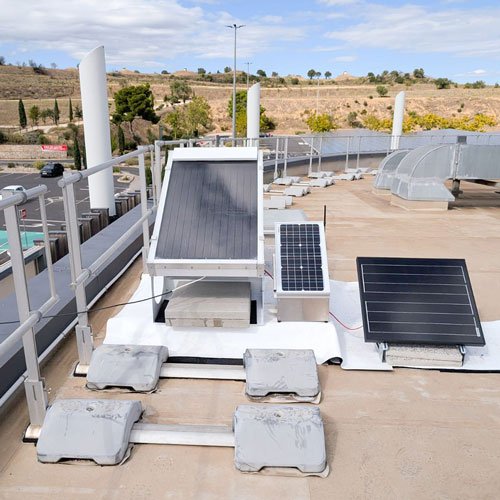
The installation was put in place in September 2025 on the roof of the Aushopping Porte d’Espagne shopping centre in Perpignan.
🔧 Installation
The atmospheric water generator was placed on the roof of the shopping centre. It runs entirely autonomously, using solar energy to drive the condensation process that extracts moisture from the air.
💦 What is it for?
In this pilot phase the water produced is not intended for human consumption, but for watering a plant-covered pergola installed beneath the roof — a climbing plant chosen for its ability to survive on very little water, symbolising the water autonomy that is possible in urban areas facing shortages.
4. Results and how it works
📊 The generator captures atmospheric humidity and then condenses it using solar heat, producing water used directly for irrigation.
At 30 °C with a relative humidity of around 60%, the system can produce up to roughly 1 litre of water per day per square metre of exposed surface.
💡 This process shows that it is possible to water planted areas without drawing on the mains supply, with an autonomous installation on structures that already exist (such as building roofs).
5. The parties involved
The project brought together several local partners around this ecological and innovative goal:
- Water ECOsystem (the start-up behind the design).
- UPVD IN CUBE (business incubator at the University of Perpignan).
- GCEI France and Jardin de Provence Roussillon, involved in monitoring and the landscaping.
- Ceetrus, the shopping centre operator.
6. Reactions and scope of the experiment
👍 Positive reactions
- Local players and partners welcomed the initiative as a concrete innovation, demonstrating a way to irrigate urban green spaces even during a water shortage.
- The inauguration event on 23 October 2025 — attended by the founders and partners — highlighted the enthusiasm for sustainable solutions of this kind.
🧠 What it shows
Even though output remains modest (≈1 L/m²/day), this demonstrator is a proof of concept with strong symbolic impact:
✔️ this type of technology can be integrated into existing buildings,
✔️ partial water autonomy is achievable for non-drinking uses,
✔️ it contributes to the ecological transition and to adapting to increasingly frequent droughts.
7. Limits and outlook
🌱 Current limits
- The pilot phase does not produce volumes sufficient for drinking water at scale.
- The technology still depends on local climatic conditions (temperature and humidity).
🚀 Future prospects
This type of installation could be adapted to a range of uses:
👉 urban irrigation in other water-scarce areas,
👉 pilot projects run by local authorities,
👉 integration into public spaces or infrastructure with IoT monitoring to optimise output.
🧾 Conclusion
The atmospheric water generator project in Perpignan is a recent, concrete case of this technology being adapted to a local climate emergency: drought and water stress. Set up by a French start-up with local backing, it demonstrated that it is possible to extract water from the air to meet autonomous irrigation needs, while convincing partners, residents and public bodies of the value of such solutions for the future.