The two questions you ask yourself once the machine is installed are rarely covered before purchase: how much noise does it make, and what does a litre cost. The first falls under the French public health code. The second can be calculated, and physics imposes a limit nobody can cross.
1. Power use: what thermodynamics imposes
Producing a litre of water from air means taking that water from vapour to liquid. That change of state releases a fixed amount of heat, the latent heat of condensation: about 2,442 kJ per kilogram at 25 °C, or 0.68 kWh of heat to remove per litre.
A generator does not remove that heat by magic: it uses a refrigeration cycle, like a fridge. Even crediting it with a generous coefficient of performance of 3 — three units of heat moved per unit of electricity consumed — it would still need roughly 0.23 kWh of electricity per litre.
That figure is an optimistic floor, and it should be said plainly: it counts only the latent heat. It ignores cooling the entire volume of air passing through the machine, the fan, the UV lamp and the electronics. Real consumption is therefore markedly higher.
The value of the calculation lies elsewhere: it sets a bound. Any marketing claim below 0.2 kWh per litre is physically impossible, whatever the argument. It is a simple test to apply to a data sheet.
2. Turning kWh into euros
Manufacturers quote watts, which tells you nothing. The only useful unit is kWh per litre produced, measured under stated conditions. Ask for it.
The calculation is then direct: consumption (kWh/L) × your price per kWh × 1,000 = cost per cubic metre. As an illustration, a machine at 0.3 kWh/L with electricity at €0.20/kWh produces a cubic metre for about €60. That figure depends entirely on your tariff and on real conditions; it is given to show the method, not as a benchmark.
This order of magnitude places the technology: well above mains water, which costs a few euros per cubic metre, and well below bottled water. It is consistent with what we wrote in our comparison of the four solutions: you do not buy a generator to save on mains water, but to do without it.
One last point, often forgotten: consumption per litre rises as the air gets poorer. In January the machine moves more air for the same litre. Our city-by-city and season-by-season figures are in output by region.
3. Noise: what French law says
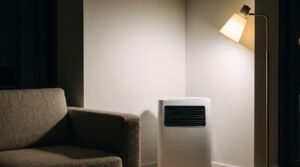
An atmospheric water generator contains a compressor and a fan. It therefore makes noise continuously, in the same register as a fridge or a dehumidifier.
Two legal regimes coexist, and they should not be confused.
Domestic use
In a private home, the machine falls under behavioural noise. No decibel measurement is needed to establish the offence: what counts is the duration, repetition or intensity of the noise, once it disturbs the neighbourhood’s peace. A machine on a balcony that is audible at night next door is therefore a problem even if it looks discreet on paper.
Professional use
For a business activity, the emergence rule applies, set out in article R. 1336-7 of the French public health code. The installation’s noise must not exceed the ambient noise by more than 5 dB(A) between 7 am and 10 pm, nor by more than 3 dB(A) between 10 pm and 7 am, with a corrective term depending on how long the noise lasts. Breaches are penalised under articles R. 1336-14 to R. 1336-16 of the same code.
The practical consequence is counter-intuitive: the limit is set by the background noise of the place, not by an absolute value. The same machine can be perfectly lawful beside a road and a problem in a quiet street at night.
4. Three questions to put to the seller
- The sound power level in dB(A), and the standard it was measured to. A figure without a method is worthless.
- Behaviour in reduced mode: does the machine have a night mode, and what does it produce in it.
- Consumption in kWh per litre, at two different temperature and humidity conditions, not just one.
5. Reducing both at installation
- A machine placed in a heated room works in air richer in water: it produces more, so it consumes less per litre.
- A utility room, pantry or attached garage moves the noise away from living spaces without hurting output, provided the room is not cold.
- Avoid direct contact with a lightweight partition: compressor vibration travels better through structure than through air.
- Running the machine during the day rather than at night settles both the neighbour question and, depending on your contract, the tariff one.
Conclusion
Noise and power use are the two subjects data sheets are most evasive about, and the two you live with every day. Keep two markers in mind: no machine can go below roughly 0.2 kWh per litre, and in France the noise limit is not an absolute figure but a gap against the surrounding quiet. With those two rules, a data sheet becomes readable.
Sources
- Latent heat of vaporisation of water at 25 °C: about 2,442 kJ/kg, or 0.68 kWh per litre. The electrical floor is obtained by dividing that value by a hypothetical coefficient of performance of 3.
- French public health code, article R. 1336-7: emergence limits of 5 dB(A) during the day (7 am-10 pm) and 3 dB(A) at night (10 pm-7 am), with a duration-based corrective term. Penalties under articles R. 1336-14 to R. 1336-16.
- French Ministry for Ecological Transition, Noise, noise nuisance and noise pollution.